
Plans and Samples
...The style of houses used for poultry changed many times. The pendulum has swung from open (letting birds roost in trees) to closed (windowless houses of about 1850) to open (wire range shelters about 1910) to closed (Petaluma type houses in 1920) to open wire cages (early 1950's) to closed (controlled environment houses of 1960 to 1973). --Wilbor Owens Wilson, "Housing" in American Poultry History: 1823-1973: An Anthology Overview of 150 Years (1974, p. 223).
Wilson's survey of poultry housing systems from 1823 - 1973 observes that there was wide variations in style and structure across these decades.
The following books contain the types of plans and designs that were considered modern to Frost's agricultural contemporaries: poultry farmers of the early 1900s.
Selected Item: Poultry Architecture: A Practical Guide for Construction of Poultry Houses, Coops and Yards
George P. Fiske, 1902
"The aim of this book is to give designs of sufficient variety to suit conditions everywhere. Few requests come more often to the office of a poultry editor than those asking designs and directions for some part of a poultry plant. The number and variety of such requirements is surprising."
Practical Farm Buildings: Plans and Suggestions
A.F. Hunter, 1905
Describes Dr, Charlemagne Bricault's "New-Idea" Poultry House and the Maine Experiment Station's Curtain-Front House
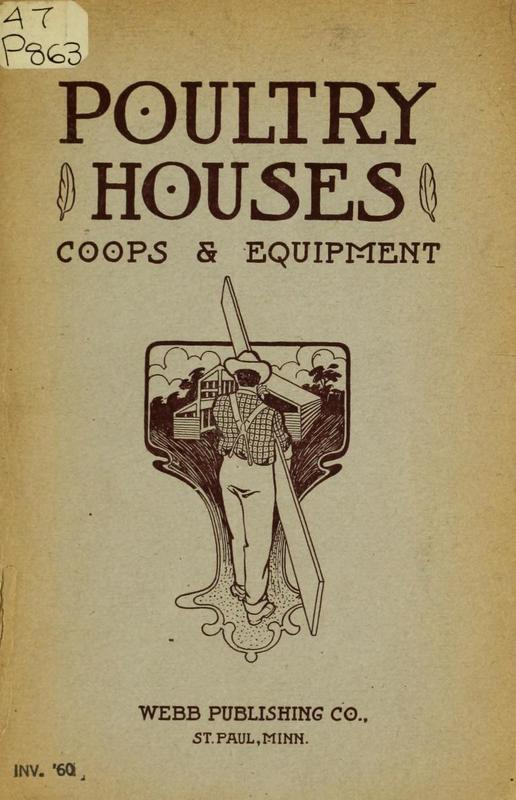
Poultry Houses: Coops & Equipment: A Book of New Plans for Building Practical, Up-To-Date Colony Houses, Continuous Houses, Roosting Coops, Brood Coops, Fixtures and Utensils; for the Farmer, the Village Poultry Keeper and the Exclusive Poultry Raiser
Webb Publishing Company, 1906
"It is easier and less expensive to build a poultry house on the most advantageous location and to construct it properly than it is to change it after it is built, to meet the requirements. The matter of location is an important one. Permanent poultry buildings should never be located upon heavy soil if it can be avoided. Such soil is better adapted to other purposes. Light, sandy soil, but not so light that it will not produce a good crop of grass when fertilized, is considered the best on which to build poultry houses and yards. The impurities are driven into such a soil by the rains and the yards are to some extent self-purifying. In high latitudes where the temperature runs very low in winter, protection from heavy winds is very desirable. On that account poultry buildings are located on the south or east side of a hill or rising ground, when such a location is to be had, or on the south or east side of a thick grove of trees."
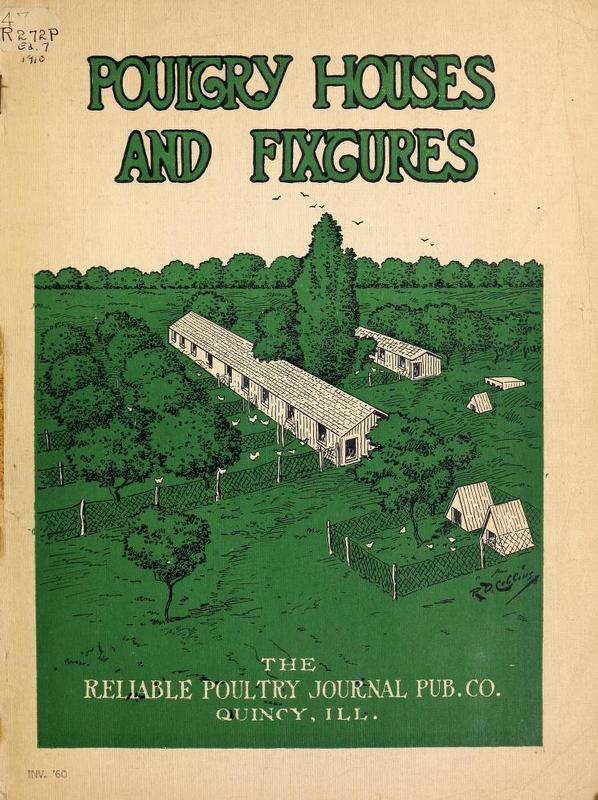
Poultry Houses and Fixtures: The Plans and Details for Constructing Closed Front, Scratching Shed, Curtain Front, Fresh Air and Portable Poultry Houses And Appliances for House and Yard
The Reliable Poultry Journal Publishing Company, 1910
"Poultry houses and fixtures are among the first considerations of a person about to begin breeding poultry. If the buildings are commenced in a haphazard kind of a way disappointments and loss of time are bound to ensue. It will, therefore, be the endeavor in this book to assist the breeder in avoiding the difficulties which arise with a first attempt at poultry house building, in addition to which we will place before the already experienced poultryman plans which his fellow-breeders adopt. We present illustrations and descriptions of houses for the city and village fancier and for the professional breeder who intends establishing a large plant. The farmer, also, will find plans suited to his requirements."
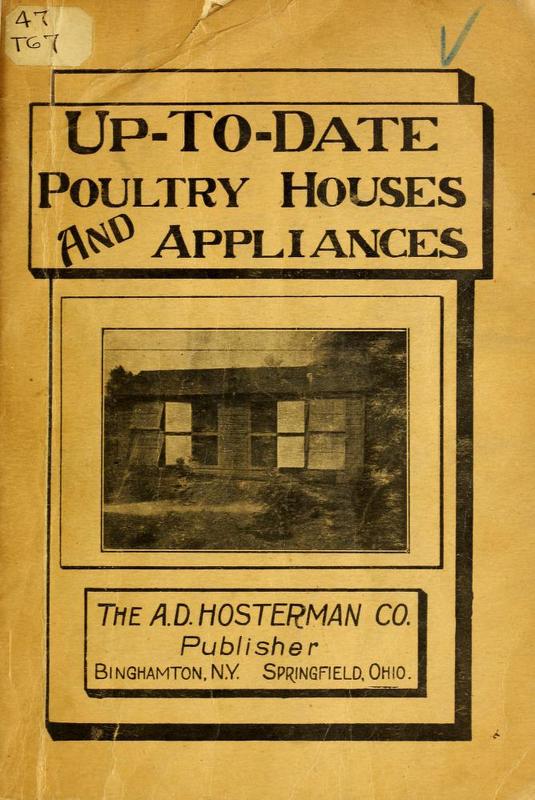
Up-To-Date Poultry Houses and Appliances
Trafford, Henry. Editor and Compiler
Trafford, C. F. Illustrator, 1911
"The contents of this book is a compilation of illustrations with word descriptions by the Author and Editor of Poultry Success, such as are in actual and practical every day use by leading and successful poultry raisers, not only those who raise a few hundred birds each, but those whose annual output reaches into the thousands, the utility poultry raiser as well as the fancier."
Making A Poultry House
Mary Roberts Conover, 1912
"To close one's eyes and dream of a home in the country with its lawns, its gardens, its flowers, its songs of birds and drone of bees, proves the sentimental in man, but he is not practical who cannot call into fancy's realm the cackle of the hen."
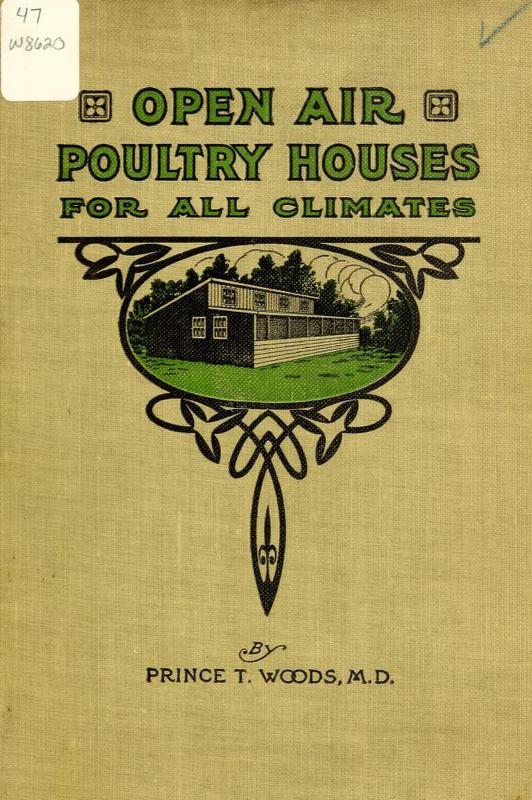
Open-Air Poultry Houses For All Climates: A Practical Book on Modern Common Sense Poultry Housing for Beginners and Veterans in Poultry Keeping. What To Build and How To Do it. Houses That Will Promote Health, Vigor and Vitality in Laying and Breeding Stock
Woods, Prince Tannat, 1913