
Incubators
Third Annual Catalogue of the Cyphers Incubator Company
The Cyphers Incubator Company, 1899
"It will be perceptible to the most casual reader that any incubator that has built up in but two seasons a reputation such as the Cyphers now enjoys as a leader the world over, must have some points of merit over the old style machines which its competitors are manufacturing.
We will here endeavor to show in what way it excels; and further, knowing full well that many who have entered the field of poultry raising failed, we shall also point out why some met with disaster, how it could have been avoided, and why the few are succeeding. In other words, we shall try to show the hard business side of this rapidly growing industry, and instruct those who are about embarking in poultry raising how to avoid the shoals on which their less fortunate brothers wrecked. We shall give matter not only of value to the beginner, but also to the old and experienced poultry raiser."
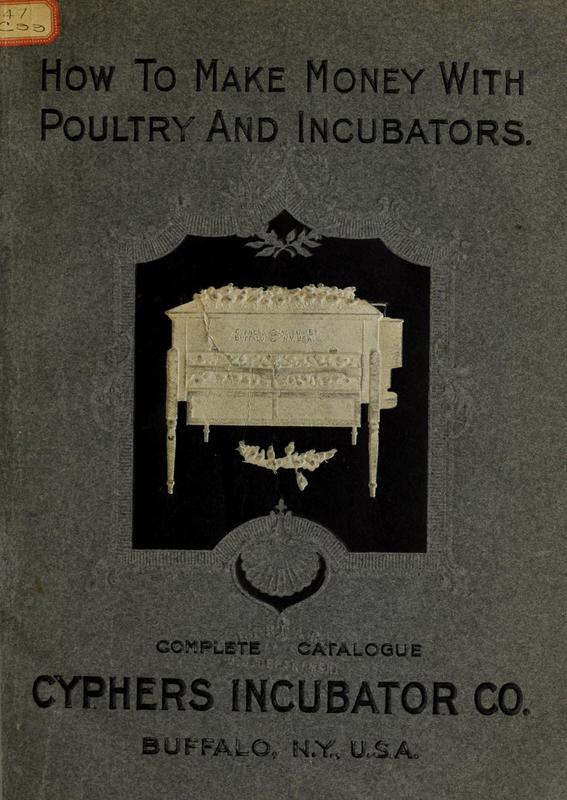
Seventh Annual Cataloge of Cyphers Incubator Company: Manufacturers of the Cyphers Non-Moisture, Self-Ventilating and Self-Regulating Incubators, The Improved Cyphers Brooders and A Full Line of Poultry Appliances, Also Dealers in Poultry Supplies
The Cyphers Incubator Company, 1903
"Up to six years ago, when the Cyphers was placed on the market, a non-moisture, self-ventilating incubator had never been heard of in America, or in any other country. The Cyphers, therefore, is the original and only genuine non-moisture and self-ventilating incubator. Other so-called non-moisture and self-ventilating incubators are either imperfect imitations, or, worse still, are merely the old-style machines, without alteration, now claimed to be non -moisture and self- ventilating in order that unscrupulous manufacturers may reap where others have sown, regardless of truth and right.
The Cyphers Incubator was placed on the American market in November, 1896, and at once attracted the attention of practical poultrymen, because of the ease and simplicity with which it could be operated, and the remarkably good work it did in hatching chicks and ducklings. Almost at once it took first place in the United States and Canada as a practical hatcher, and in the succeeding years it has steadily and rapidly grown in the appreciation of the public, until it has outstripped all competitors. The secret of this remarkable success was the application of the principle of diffusion to artificial incubation, together with honest value put into every machine placed on sale."
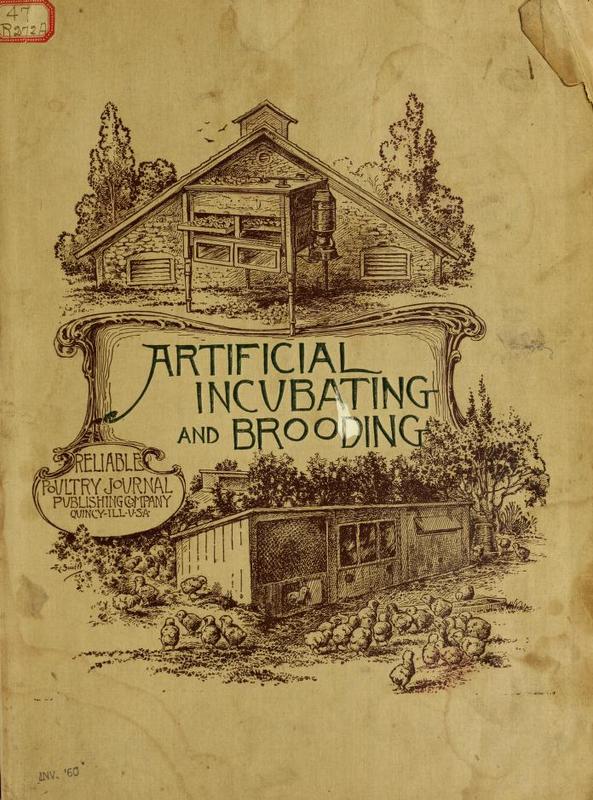
Artificial Incubating and Brooding
Reliable Poultry Journal Publishing Company, 1906
"A person who is at all well informed will not dispute the claim that the poultry business in the United States is now an important national industry. As a matter of fact, it is one of the most important, not alone in this, but in every other civilized country, for poultry and eggs are much esteemed the world around as a highly nutritious and palatable human food. These articles are admitted to have only one rival as a natural, complete and nutritious food, namely, milk and milk-products. The poultry industry rests solidly upon the actual value of poultry and eggs as food and will endure, therefore, as long as mankind exists. Its future will be identical, in a true sense, with that of the human race. Increase of population will mean a corresponding increase in the production of these well-nigh indispensable food products."
Incubators: Cyphers Brooders, Poultry Houses and Appliances, Poultry Foods, Clover and Alfalfa Products, Insecticides and Remedies. Eleventh Annual Catalogue
The Cyphers Incubator Company, 1907
"Among the pages of this Annual Catalogue and Guide will be found two chapters that are of special interest ; one tells of the remarkable growth and present magnitude of what today is known as, the Poultry Industry; the other describes and seeks to explain the rapid increase in the prices of market poultry and eggs during the last six years. The contents of these two chapters will prove a revelation, not only to the general reader, but to many persons who consider themselves well informed on poultry subjects. The development of the poultry industry in its more important branches has been so rapid during the last ten years that few persons, if any, know the facts. We are convinced that not one of us realizes at the present time the extent of the still greater progress this industry is destined to make within the next few years.
What today is referred to commonly as the poultry industry did not exist twenty-five or thirty years ago. Poultry culture — meaning the breeding of fowls for fancy points — was followed forty and fifty years ago, as a business, by a limited number of enthusiasts, but the wide-spread production of poultry for table consumption did not become an industry until a way was discovered and the means invented to hatch eggs, and raise chicks and ducklings, in practically unlimited numbers."
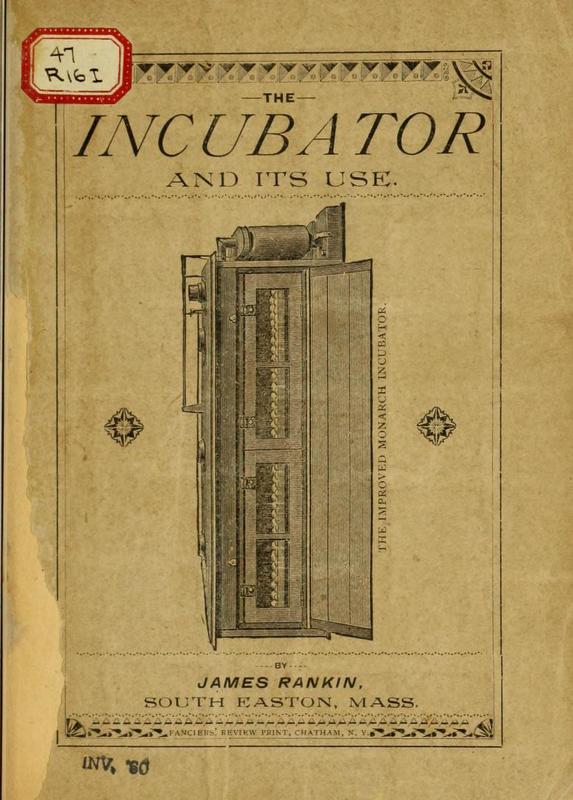
The Incubator and Its Use
James Rankin, 1907
"I am induced to place this little work entitled 'The Incubator and its Use,' before the public for various reasons. One is, that we are constantly flooded with letters from all parts of the country asking innumerable questions on the subject, of which the following are specimens: 'Which is the best incubaator?' 'What is the proper degree of heat to run?' 'Is electricity a good regulator?' 'How much moisture shall I use, and when?' 'Is a hot-air machine as good as hot water?' 'What is an incubator?' 'How does it look?' 'How often do you turn your eggs?' 'How do you manage when chicks are coming out?' 'Please give me the whole thing in detail?' 'What is your percentage of hatch?' Of course, with a correspondence of from fifty to seventy letters per day, the detail business is out of the question. Another reason is, that there is a great deal of ignorance and prejudice prevailing regarding the use and utility of incubators. Many never heard of one and are plodding quietly and contentedly along with the old hen. Others say that it is an unnatural way of doing the thing and never can succeed. Others still have had bitter experience in the use of machines and have lost their chicks through the use of still more worthless brooders; they have become skeptical and denounce the whole thing as impracticable. Many are groping in the dark, wishing to know and anxious to learn all they can of the business and are willing to pay well for the knowledge, but there is no work in existence, as yet, that will cover it; and it will be years before the subject will be mastered in all its details. For more than thirty years I have been carefully experimenting with incubators and the system of incubation. It has been to me a long course of patient study and scientific investigation, with a gradual gain and steady improvement for the better; with the dark places showing a glimmer of light; obscure points being made plain. But the end is not yet. I am no longer young. The infirmities and decrepitude of age are slowly creeping upon me and admonish me that my days of research are nearly over and I find that life is all too short; but there is a satisfaction in knowing that others will take it up and carry it on to the end. I predict a great future for the incubator. With me it has been a decided success; and if the rehearsal of my experience will make the business of growing poultry of all kinds as profitable to the reader as it has been to me, I could wish him no better fortune."
Chickens and How to Raise Them: All About Chickens, How to Hatch, House, Feed and Fatten Them and Cure Their Diseases
A.T. Johnson, 1910
"In the following pages the author deals in a systematic and thorough way with the subjects of natural and artificial incubation, and the rearing of chickens. He commences with a chapter on Nature's method of incubation, then fully describes the wonderful structure of an egg, following with chapters on the development of the embryo, the importance of securing good eggs for incubation, incubation by the hen and by artificial means; the merits and otherwise of moist and non-moisture incubators and their management, the rearing of chickens by natural and artificial means, weaning and feeding the chickens, rearing in winter; concluding with some sound useful advice regarding various common ailments in chickens."
Successful Incubation: A Working Manual for Large Hatching Plants
Peter Cook, 1911
"This little book gives our experiences in hatching conducted for about six years. It is the story of our investigations, how we have finally stumbled on to the right way to hatch chicks. It is hoped it will save many the heart-rending experiences we have gone through. When you once know how, it is simple enough to hatch chicks, but it is not always easy to find out the simple way.
We also hope that there will be no disappointment to our readers. It seems that most poultry books are written by persons sitting by a cosy fire spinning theories that are utterly impracticable. This book is based on actual hatchery work and every effort has been made not to mislead any one or make claims unsupported by actual facts.
But there is still room for improvement and we shall be glad to hear from our readers if difficulties persist. All letters to me should be addressed to the publishers of the book, and they will be forwarded."
How To Raise Chicks. Including Revision of Facts about White Diarrhoea. A Practical Book That Tells How to Select and Manage Breeding Fowls, What You Want To Know About Foods and Feeding, How to Get Hatchable Eggs, How to Hatch With Hens or Incubators, How to Brood and Raise Chicks, What White Diarrhoea Is and How to Prevent It
Prince Tannat Woods, 1912
"Raising the chicks has been named as the most difficult "poultry problem" and some poultrymen say that "everything else is easy." If one begins right, with well born chicks, chick rearing ought not to prove so very difficult. What is meant by beginning right?
For success the rearing of chicks should begin with the parent stock. You must have good healthy hatchable eggs in order to get good livable chicks. You can't get good healthy hatchable eggs unless you breed for health and manage for comfort. Select your breeding stock with great care to get the maximum of constitutional vigor; so manage and care for them that they will be comfortable, contented, and happy, and you will find them productive and possessing abundant vigor, vitality and health. These good and necessary qualities will prove an invaluable hereditary asset when the time comes for hatching eggs and rearing chicks."
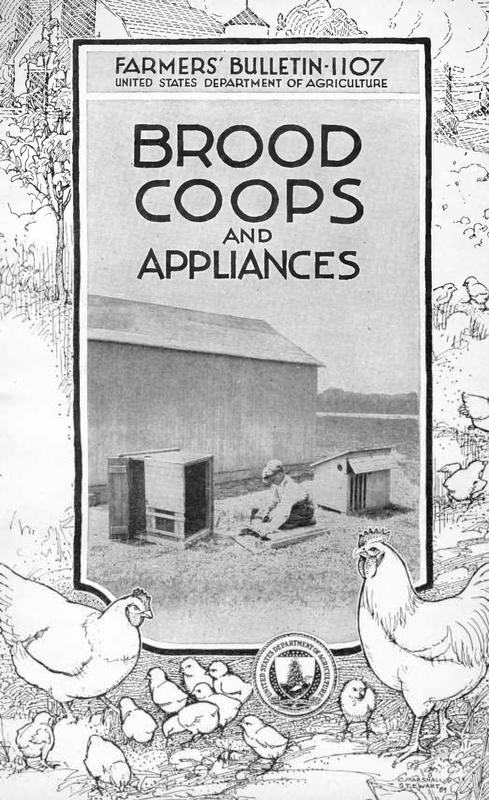
Brood Coops and Appliances
Daniel Monroe Green, 1920
"Every boy and girl club member should provide a good coop for the mother hen and little chickens. If you do not have one already, it should be built before it is time for the little chicks to hatch. Many boys and girls build their coops in the wintertime so as to have them ready for use in the spring, and when this is done a nest box can be placed in the coop and used for the sitting hen. A properly constructed coop is a good place for hatching chickens as well as for brooding them. When chickens are hatched in the brood coop, however, the nest should be removed and the coop thoroughly cleaned and disinfected before putting the hen in with her chickens.
The two brood coops ("A" shaped and box coop as illustrated in figs. 1 and 2) can be made easily from dry-goods boxes or other available material. The 'A'-shaped coop, as shown in the illustration on page 3, is collapsible so that it can be easily cleaned or stored away in winter. Or if desirable, it may be built stationary by simply nailing fast the top, back, and slats in front and placing it on a removable bottom. A wire-screen door (1-inch mesh or smaller) * of some sort should be provided, as shown in the illustration of the collapsible coop (fig. 1), to place over the front at night. This will prevent rats and other enemies from entering the coop and killing the chickens, and will also keep the little chicks confined early in the morning, when the grass is wet A hook or clasp should be put on the door to hold it firmly in place."

Incubation: A Working Manual For Large Hatching Plants, Second Edition
Peter Cook, 1923