
Overview of Hen Housing and Welfare
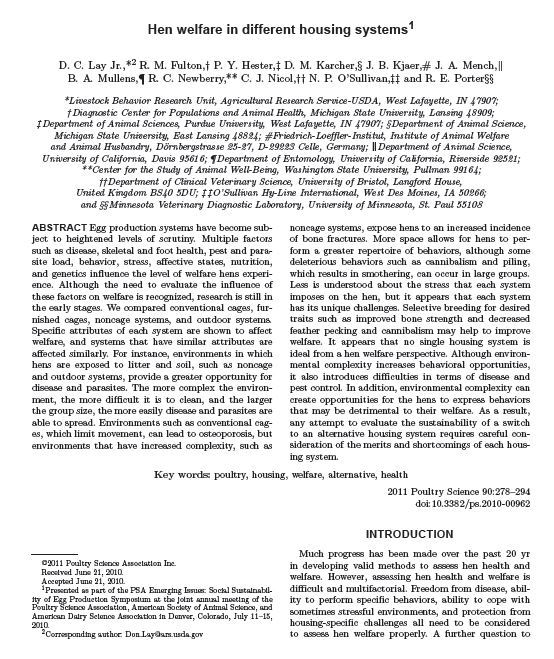
Dr. Donald C. Lay, Jr., Research Leader of the USDA's Livestock Behavior Research Unit (part of the Agricultural Research Service) provided a summary of the article "Hen Welfare in Different Housing Systems" (Lay D.C., Fulton, R.M., Hester, P.Y., Karcher, D.M., Kjaer, J.B., Mench, J.A., Mullens, B.A., Newberry, R.C., Nicol, C.J., O'Sullivan, N.P., and Porter, R.E., 2011) for inclusion in a USDA fact sheet. It provides an overview of housing considerations for chickens, especially those raised for egg production. It is quoted below; original full text is here
Laying Hen Housing and Welfare (2011)
Background:
Assessing hen health and welfare is difficult and requires the consideration of many factors including freedom from disease, ability to perform specific behaviors, and protection from housing-specific challenges. Unfortunately, it is not easy to say that one housing system is better than another as hen welfare is more readily influenced by the attributes of a system (such as space, perches, etc.) which may negatively impact a component of welfare. The usual case is that changing one housing attribute to improve a specific element of hen welfare leads to a conflicting result that impairs another element of the hen’s welfare. For instance, providing hens with more space so that they can roost allows the hen to perform a natural behavior, which she has a high degree of motivation to perform; however, this environment also causes increased incidence of broken bones, due to miscalculated landings on the perch or floor. Thus, learning to manage the hen’s welfare in all production systems is the key to improving hen welfare.
Housing Options and their Challenges:
There are four main housing types that can be categorized as: conventional cages, furnished cages, non-cage systems (barns or aviaries), and outdoor systems. The advantages of conventional cages are that they allow for thorough cleaning, which decreases disease and some parasites; however, due to close proximity when hens do get disease or parasites they spread rapidly. The disadvantages of conventional cages are that they limit the expression of behavior, and bone breakage can occur, if not careful when the hens are removed from the cage. Furnished cages have the advantage of allowing the hen to perform a fuller repertoire of behavior and hens have lower risk of bone breakage compared to conventional and more extensive systems; however, due to increase complexity of the environment they can harbor pests such as the red-mite. Non-cage and outdoor systems allow a full expression of hen behavior; however, diseases, parasites, cannibalism and broken bones can all become a challenge to hen welfare. Mortality is generally lower in furnished cages when compared to conventional cages, and mortality can reach unacceptably high levels in non-cage systems
Recommendations: